Panama Canal: how the US built the Big Ditch (1904–1914)

Panama Canal: how the US built the Big Ditch (1904–1914)

A 5,142-word engineering teardown of the original Panama Canal construction (1904–1914): why the US chose a lock-and-lake design after the French sea-level attempt killed 22,000 workers; how John Frank Stevens argued Theodore Roosevelt into overruling an 8-to-5 engineering panel; the Culebra Cut's 76 million m³ of excavation and unrelenting landslide battle; Gatun Dam's hydraulic-fill construction (world's largest earthfill dam at completion); Gorgas' epidemiological campaign that eradicated yellow fever in 18 months; and the gravity-fed lock culvert system that still moves ships through 25.9 metres of elevation change with no pumps.

Engineering Marvel Teardown
June 11, 2026 · 11:27 PM
4 subscriptions · 28 items
In May 1879, Ferdinand de Lesseps stood before 136 delegates in Paris and declared that a sea-level ship canal across Panama was not only possible — it was inevitable. He had, after all, just built the Suez Canal, slicing a flat, sandy isthmus in ten years with no locks and minimal drama. Panama would be the same. 1
He was catastrophically wrong. Ten years and roughly $287 million later (about $10.3 billion in 2025 terms), the French effort had killed an estimated 22,000 workers, devoured the savings of 800,000 French investors, and left behind a partially excavated trench that was slowly sliding back in on itself. 1 The United States would spend another decade and nearly $500 million finishing what France could not start correctly — and would do so by making a series of engineering decisions that were almost the opposite of de Lesseps' instincts at every turn.
The Panama Canal, opened officially on August 15, 1914, is an 82-kilometer (51-mile) waterway connecting the Atlantic and Pacific oceans across the Isthmus of Panama. 2 The American Society of Civil Engineers (ASCE) named it one of the Seven Wonders of the Modern World. 3 What follows is the engineering case study behind that designation.

The 1879 failure: why de Lesseps' mental model was wrong

At the 1879 International Congress in Paris, the chief engineer of French Bridges and Highways, Baron Godin de Lépinay, presented a lock-and-lake canal design: dam the Chagres River at Gatun to create a large artificial lake, cut through the Continental Divide, and use locks on both sides to raise and lower ships. His estimated cost: $100 million. He was dismissed. 1
Of the 136 delegates at the Congress, only 42 were engineers. The rest were speculators, politicians, and friends of de Lesseps. The final vote was 74 to 8 in favor of the sea-level approach. Only 19 engineers voted yes; the five delegates from the French Society of Engineers refused to endorse it. The single engineer who had actually visited Central America was not among those 19. 1
This mattered because Panama is not Suez. The fundamental differences undermined the sea-level approach before a shovel touched the ground:
  • The Chagres River — running directly across the proposed canal path — was a mild stream in the dry season and a torrent in the wet season, rising up to 10 meters (33 feet). A sea-level canal meant this river either had to be fully diverted or managed through an unrealistically large dam at Gamboa. Neither proved workable.
  • The Continental Divide presented a rock mass of unstable geology — not the flat, stable sand of Suez. Culebra Peak stood 64 meters (210 feet) above sea level at its lowest point along the proposed route. Cutting through it to sea level was geometrically vastly more demanding than cutting to an elevated lake level.
  • Tropical disease — specifically yellow fever and malaria — was not a known engineering variable. The mechanism of mosquito-borne transmission had not yet been established. Workers arrived, sickened, and died. By 1884, deaths exceeded 200 per month. 4
The French company, Compagnie Universelle du Canal Interocéanique, folded on May 15, 1889. De Lesseps himself was later convicted of misappropriating funds, though the verdict was ultimately overturned and the 88-year-old was never imprisoned. 1 His proposal had cost 22,000 lives and the savings of nearly a million French citizens.
De Lépinay's lock-and-lake design — dismissed at the 1879 Congress — was almost exactly what the United States would eventually build.

The lock-canal decision: Stevens vs. an engineering panel

The US acquired the French assets in 1904 for $40 million (roughly $30 million attributable to the existing Culebra Cut excavation), after a sequence of political maneuvers: the Spooner Act of 1902 authorized a Panama route over Nicaragua, the Hay–Bunau-Varilla Treaty of November 1903 granted the US a ten-mile-wide Canal Zone in perpetuity, and Panama itself had just declared independence from Colombia under the watchful guns of USS Nashville. 2
The first US chief engineer, John Findley Wallace, resigned in June 1905, overwhelmed by disease, dilapidated French equipment, and bureaucratic obstruction from the Isthmian Canal Commission (ICC). His replacement was John Frank Stevens, a self-taught railroad engineer who had built the Great Northern Railroad across the Rocky Mountains. Stevens was not an ICC member and reported directly to the Roosevelt administration, bypassing much of the commission's friction.
In January 1906, a US engineering panel voted 8 to 5 to recommend a sea-level canal — essentially rerunning the French decision. Stevens had seen the Chagres River in full flood. He was summoned to Washington and told President Theodore Roosevelt that a sea-level canal was "an entirely untenable proposition." 2 The US Senate voted 36 to 31 to adopt the lock canal design. Roosevelt cast the deciding political weight.
The lock-and-lake concept had a clear engineering logic. Instead of excavating an additional 85 feet of rock through the full length of the Culebra Cut, the canal would:
  1. Dam the Chagres River at Gatun, creating a large artificial lake at 26 meters (85 feet) above sea level
  2. Use the existing lake elevation as the canal's navigable surface for 33 km across the isthmus
  3. Step ships up from the Atlantic through three lock chambers at Gatun (+26 m)
  4. Step ships down on the Pacific side through single-step Pedro Miguel locks (−9.4 m) and two-step Miraflores locks (−16.5 m)
This substituted hydraulic engineering for rock excavation. It did not eliminate the digging problem — the Culebra Cut still had to be cut to a navigable depth — but it reduced the required depth from sea level to the lake surface, a difference of roughly 26 meters across the full 12.6-km cut.
Stevens had another insight that shaped the entire project: "The digging is the least of our problems." Before large-scale excavation could begin, he argued, the supporting infrastructure had to exist. He spent his first year rebuilding housing, cafeterias, water systems, repair workshops, and — critically — the Panama Railroad. The railroad's upgrade to heavy-duty double track was not incidental; it was the logistics backbone that would move tens of millions of cubic meters of excavated material from the cut to dump sites 19 km away. Without it, the shovels would have had nowhere to put what they dug. 1
Stevens resigned in early 1907, possibly worn down by ICC friction. Roosevelt replaced him with George Washington Goethals (1861–1928), a US Army Corps of Engineers officer — a signal that the project would now run on military command authority. Goethals divided the work into three geographic divisions: Atlantic (Major William L. Sibert — Gatun locks, dam, breakwater), Central (Major David du Bose Gaillard — Culebra Cut), and Pacific (Sydney Williamson — Miraflores and Pedro Miguel locks). He finished the canal in August 1914, two years ahead of the June 1916 target date. 2

The Big Ditch: Culebra Cut and the landslide problem

The Culebra Cut — renamed Gaillard Cut in 1915 after its chief engineer died — is a 12.6-kilometer (7.8-mile) artificial valley through the Continental Divide, the single most difficult engineering task on the project. 5
The French had excavated 14,256,000 m³ (about 18.6 million cubic yards) over eight years and lowered the summit from 64 meters to 59 meters above sea level. They targeted a bottom width of 22 meters — the minimum for a sea-level canal. The US excavated more than 76,000,000 m³ (100 million cubic yards), lowering the summit to 12 meters above sea level and widening the bottom to 91 meters (299 feet). The top width at the broadest points reached 540 meters (0.34 miles). 5
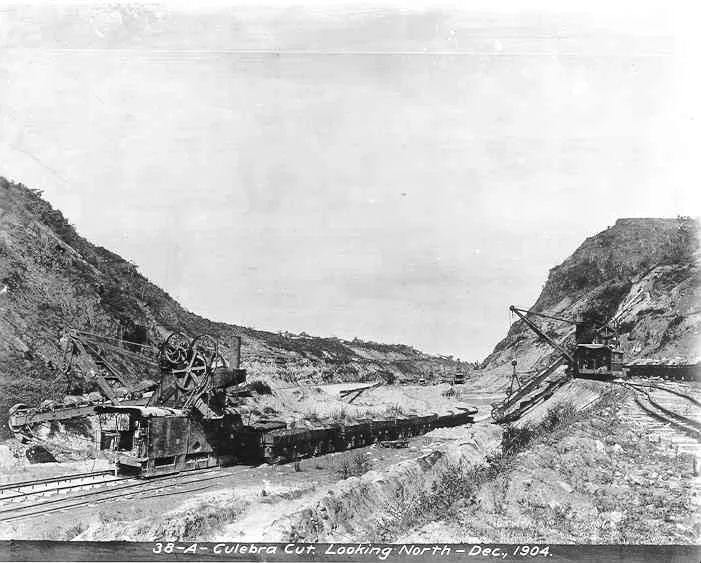
(Culebra Cut looking north, December 1904: the narrow French-era slot, with US steam shovels beginning to widen it on rail-mounted platforms.) 5
The excavation mechanics relied on explosives and rail-mounted steam shovels. The blasting program consumed 27,000 metric tonnes (60 million pounds) of dynamite over the course of construction — approximately 200,000 kg per month at peak, with over 600 blast holes fired daily and single charges as large as 24 metric tonnes. 5 A compressed-air pipeline network stretching 50 km drove hundreds of pneumatic drills boring the blast holes.
The shovels then loaded the broken rock into spoil trains. At peak activity, 160 trainloads per day departed the cut for dump sites, with trains passing nearly every minute. 5 Six thousand workers were in the cut simultaneously.

The landslide problem

The International Board of Consulting Engineers had predicted the excavated slopes would remain stable at 73.5 meters height with a 1-in-1.5 gradient. In practice, failures began at just 19.5 meters (64 feet). The root cause was geology: water infiltration oxidized iron-bearing strata, and underlying shale layers underwent strain softening. The result was a material that behaved less like rock under load and more like a slow-moving fluid. 5
The first major failure was the Cucaracha slide in October 1907. Approximately 400,000 m³ (500,000 cubic yards) of clay mass washed into the cut. The clay was too soft for steam-shovel buckets; it had to be removed by sluicing with high-pressure water. David du Bose Gaillard, who led the Central Division, described the slides as "tropical glaciers, made of mud instead of ice." 5
By completion, approximately 23,000,000 m³ (30 million cubic yards) of the US excavation total represented material that had slid back into the cut after being dug out — roughly one-third of all excavation work in the Cut was re-handling slide material. The canal closed for seven months after a September 1915 landslide, even after formal opening. Engineers never fully solved the landslide problem; they managed it by continuously widening the cut, removing weight from the upper slopes, and accepting that some re-excavation would always be necessary.
Gaillard was promoted to colonel in 1913. He died of a brain tumor on December 5, 1913 — just months before the waters of Gatun Lake flooded the cut for the final time. He never saw the canal open.

Gatun Dam: engineering the world's largest earthfill structure

The lock-canal design required a dam that had never been built at this scale. Gatun Dam crosses the Chagres River near its Caribbean mouth, impounding the 425 km² (164 sq mi) Gatun Lake — itself an engineering artifact that serves simultaneously as the canal's navigable surface, the water supply for all lock operations, and the drinking water source for Panama City and Colón. 6
At completion in 1913, Gatun Dam held two world records simultaneously: the largest earth dam on the planet and the largest artificial lake on the planet.
The dam's dimensions reflect both its scale and its construction method:
DimensionValue
Crest length2,300 m (7,500 ft)
Base width640 m (2,100 ft)
Crest width (at water level)121 m (397 ft)
Height from foundation32 m (105 ft)
Crest elevation35 m (115 ft) above sea level
Total material volume~21,000,000 m³ (740,000,000 cu ft)
Approximate mass~27,000,000 long tons
The construction technique was hydraulic fill: two parallel walls of waste rock — drawn from Culebra Cut spoil, arriving at roughly 100 trainloads per day — were built about 820 meters apart. Between those walls, millions of cubic meters of clay slurry were pumped from the riverbanks. The clay settled, consolidated, and hardened into an essentially impervious core. The upstream face was armored with large boulders to resist wave action from the lake. 6
The spillway sits on a natural rock hill at the center of the dam structure — not within the earthen body itself, which avoids the risk of seepage around the spillway structure. It is a semi-circular concrete dam 225 meters (738 feet) along its crest, topped by 14 electrically operated gates each 14 meters (46 feet) wide and 6 meters (20 feet) high. Maximum discharge capacity: 4,100 m³/s (140,000 ft³/s). 6
Embedded within the dam structure is a three-generator hydroelectric station producing 6 MW total — enough to power all lock machinery, the spillway gates, and the canal's residential villages. 6
The spillway gates closed on June 27, 1913. Gatun Lake reached its operating level of 26 meters (85 feet) within roughly six months. The lake stores approximately 5.2 km³ (4.2 million acre-feet) of water — roughly equal to the Chagres River's average annual flow — providing the buffer against seasonal variation that lock operations require. 7
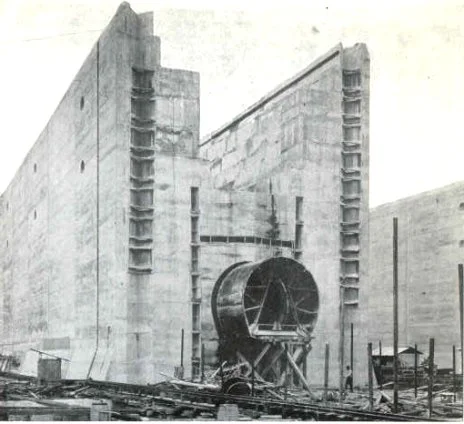
Gatun Locks under construction, 1910 — massive lock-wall formwork flanks the main culvert tube (6.71 m diameter) during concrete placement; workers visible at scale
Gatun Locks construction, 1910: the cylindrical form in the foreground is for one of the main culverts that fills each chamber by gravity 8

Lock engineering: chambers, culverts, and miter gates

The lock system is the mechanical heart of the canal. Three sets of locks — Gatun on the Atlantic side, Pedro Miguel and Miraflores on the Pacific — move ships through a total elevation change of 25.9 meters (85 feet) in each direction. 8

Chamber dimensions

Each lock chamber is 33.53 meters (110 feet) wide and 320 meters (1,050 feet) long, with a usable length of 305 meters (1,000 feet). The width is not incidental: an engineering committee originally designed the chambers at 28.5 meters (94 feet), but the US Navy intervened in 1908, arguing the chambers had to accommodate the largest existing and planned battleships. The compromise settled at 33.53 meters — a dimension that would define Panamax ship design for 102 years until the 2016 expansion. 8
The chamber walls are massive gravity structures. Side walls range from 14 to 17 meters (45–55 feet) thick at the base, tapering to 2.4 meters (8 feet) at the top. The center wall — which separates the parallel east and west lanes — is 18 meters (60 feet) thick and contains three internal galleries for drainage, electrical systems, and operator access. Concrete volume for Gatun locks alone: 1,564,000 m³ (2,046,100 cubic yards). No comparable concrete structure existed anywhere on Earth until Hoover Dam was built in the 1930s. 8

Gravity-fed water system

The entire fill-and-drain cycle runs without pumps. Gatun Lake sits 26 meters above sea level; water flows through culverts by gravity alone. The main culverts start at 6.71 meters (22 feet) in diameter — large enough to drive a train through — reducing to 5.49 meters (18 feet). Fourteen cross-culverts per chamber, each with five floor openings, distribute the inflow to prevent turbulence that would damage ships or their lines. 8
Each chamber requires 101,000 m³ (26.7 million US gallons) to fill or empty. A complete transit from ocean to ocean uses approximately 200 million liters (52 million US gallons) of freshwater — all released to the ocean, never recovered. That volume, multiplied by daily transits, sets the hydrological demand that Gatun Lake's catchment must sustainably meet. 8
Fill or drain time: roughly 10 minutes per chamber, controlled by valve opening speed rather than mechanical limits.

Miter gates

The lock gates use a miter gate design: each gate has two leaves that close in a shallow "V" shape pointing upstream. Water pressure from the higher side pushes the leaves together, producing a self-sealing closure — the higher the pressure differential, the tighter the seal. Gates can only open when water levels on both sides are equalized, which is why the culvert system must complete filling before the gates can swing. 8
The largest leaves, at Miraflores where Pacific tides produce a maximum range of over 6 meters, stand 24.99 meters (82 feet) tall. Each leaf is 19.81 meters (65 feet) wide and 2.13 meters (7 feet) thick. The heaviest individual leaf weighs 662 metric tonnes (730 short tons), yet is operated by just two 19 kW (25 hp) electric motors. The engineering trick: the leaves are hollow, buoyant structures — essentially ship hulls — that are nearly weightless in water. Each hinge weighs 16.7 tonnes. 8
Ships are not allowed to maneuver independently inside the chambers. Instead, electric towing locomotives — called "mules" after the animals they replaced — run on rack-and-pinion tracks along the chamber walls and pull ships by cable. Large vessels use eight mules simultaneously: two on each side at bow and stern. The mule tracks include 50% grade sections between chamber levels, and the locomotives use a third rail for power supply.

Pacific-side complexity

The Miraflores locks present a design complication absent at Gatun: the Pacific Ocean has a large tidal range (up to 6.4 meters / 21 feet), while Atlantic tides at the canal entrance are essentially negligible. The Miraflores lock lift therefore varies between 13 meters at extreme high tide and 20 meters at extreme low tide — a 7-meter range requiring the tallest gates in the system. Pedro Miguel, one step above Miraflores, has a fixed lift of 9.4 meters to the small artificial Miraflores Lake. 8
Loading stats card…

The invisible war: Gorgas and disease eradication

By any measure, the health campaign was as important to the canal's completion as the excavation. The French had lost an estimated 22,000 workers — the overwhelming majority to yellow fever and malaria — in eight years. The disease toll wasn't an operational risk; it was an existential one. 4
The critical difference between 1889 and 1904 was four years of science. In 1900, US Army pathologist Walter Reed's Yellow Fever Commission conducted a series of human-subject experiments in Cuba, building on work by Cuban epidemiologist Carlos Finlay, who had first proposed mosquito transmission in 1881. Reed's experiments confirmed it: Aedes aegypti was the vector. Simultaneously, Scottish physician Ronald Ross had proven, in 1897, that Anopheles mosquitoes transmitted malaria — work that earned him the 1902 Nobel Prize in Medicine. 4
Colonel William C. Gorgas (1854–1920), the Canal Zone's chief sanitation officer, had worked with Reed and Finlay in Havana and had already eliminated yellow fever there. He arrived in Panama in 1904 knowing the mechanism. He divided the zone into 11 sanitary districts plus 4 in Colón, each with inspectors who made door-to-door checks for standing water and mosquito larvae. 4
The campaign's operational components were exhaustive and expensive:
  • Standing water elimination: miles of drainage ditches dug; marshes filled; grass and brush cleared over wide areas around settlements
  • Larvicide treatment: approximately 700,000 gallons of oil and 124,000 gallons of larvicide sprayed on water surfaces where drainage was impossible
  • Fumigation: buildings were sealed and burned with sulfur and pyrethrum powder at a rate of about 2 pounds per 1,000 cubic feet of space
  • Screening: all windows and verandas fitted with mosquito netting; workers in malarial areas slept in screened quarters, since Anopheles bites at night
  • Quinine distribution: approximately one metric ton of prophylactic quinine distributed annually to Canal Zone residents to suppress malaria
  • Patient isolation: confirmed yellow fever cases were housed in portable screened cages ("Portable Fever Cages") to prevent further mosquito-to-patient-to-mosquito transmission
The ICC initially viewed Gorgas as a crank. Some commission members called his mosquito theories "barmy." 2 Stevens, when he arrived in 1905, understood the stakes and backed Gorgas fully against the bureaucratic resistance.
The results were measurable and fast. The last case of yellow fever in the Canal Zone was recorded in November 1905 — 18 months after the campaign began. By 1906, only one case was reported. By the time the canal opened in 1914, yellow fever had been zero for eight consecutive years. 4 Malaria was not eliminated but reduced enough that the workforce remained functional. The sanitation campaign cost approximately $20 million over the construction decade — large by the standards of public health spending at the time, but a fraction of the cost of the workforce casualties that had destroyed the French effort. 4
US-era worker deaths totaled approximately 5,600 over ten years — versus 22,000 in the French eight years. Of those 5,600, roughly 350 were Americans; the vast majority were West Indian laborers, who also died at rates roughly ten times higher than white workers in 1906, partly because they were more often housed outside the screened and fumigated zones. 4 After Gorgas' campaign succeeded, accident became the primary cause of death: dynamite blasts, landslide burial, falls, and machinery.

The steam-shovel machine: industrial logistics at scale

The excavation operation was industrial in a way that had no prior precedent in civil engineering. The ICC purchased over 100 railroad-mounted steam shovels: 77 from Bucyrus-Erie (Milwaukee) and 25 from Marion Power Shovel Company (Ohio). These were joined by steam cranes, hydraulic rock crushers, concrete mixers, dredges, and a comprehensive compressed-air drill network. 2
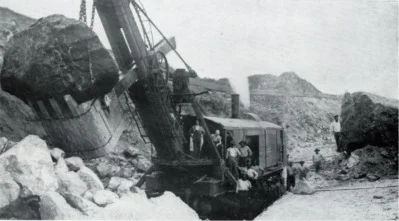
A Marion Model 90 steam shovel working a section of the Panama Canal excavation, 1908 — the shovel's dipper stick and bucket are visible against the cut face, with workers at the base for scale
Marion Model 90 steam shovel at work in the Canal Zone, 1908 2
The spoil disposal system required as much logistical engineering as the excavation itself. Spoil trains ran on the rebuilt Panama Railroad's network, hauling material to dump sites roughly 19 kilometers (12 miles) from the cut. At peak operation, 160 trainloads left the cut daily — approximately one train every nine minutes around the clock. 5 The Panama Railroad was entirely relaid with heavier rail in the process; where rising Gatun Lake submerged the original route, a new line was built at a higher elevation.
The concrete work for the locks required a separate logistical structure. At Gatun, massive overhead cableways — towers 26 meters (85 feet) tall mounted on both canal banks, strung with 6-cm (2.5-inch) steel wire cables — carried buckets holding up to 6 metric tonnes of mixed concrete across the lock structure. Electric railways fed stone, sand, and cement from dockside to the mixer, and transferred the mixed concrete to the cableways. The contractor was Philadelphia-based Day & Zimmermann (formerly Dodge & Day); the first concrete at Gatun was poured on August 24, 1909. 8
The workforce scale was enormous. Peak employment reached roughly 40,000 workers simultaneously on site, with a total of over 75,000 individuals employed over the full construction period. 2 Most were West Indian laborers — primarily from Barbados — along with Spanish, Italian, Greek, and other European workers and a smaller number of American technical staff and managers.
The workforce operated under a racially stratified pay system: the "gold roll" for white American workers and managers (paid in gold-backed US dollars with access to subsidized housing, medical care, and social facilities) and the "silver roll" for West Indian and other non-white workers (paid in local silver-backed currency with segregated and generally inferior accommodations). This system was formalized and tightened progressively between 1905 and 1908. 9
On October 10, 1913, President Woodrow Wilson pressed a button in Washington that sent a telegraph signal to Panama. The Gamboa Dike — the last earthen barrier separating Gatun Lake from the excavated Culebra Cut — detonated and collapsed. Lake water flooded the cut, joining the Atlantic and Pacific watersheds through the canal route for the first time. The SS Ancon made the first official transit on August 15, 1914 — the same week the outbreak of World War I canceled whatever grand celebration had been planned. 2
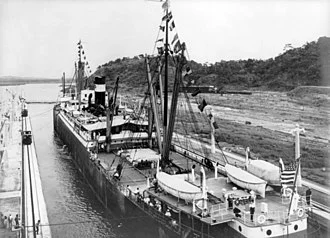
SS Ancon entering the west chamber of the Panama Canal locks on August 15, 1914, making the first official transit of the completed waterway
SS Ancon completing the first official transit of the Panama Canal, August 15, 1914 2

Engineering specifications at a glance

ParameterValueNotes
Total canal length82 km (51 mi)Deep water to deep water
Lock chamber width33.53 m (110 ft)Defined "Panamax" until 2016
Lock chamber length320 m (1,050 ft); 305 m usable
Lock total lift (each direction)25.9 m (85 ft)Gatun: +26 m; Pedro Miguel: −9.4 m; Miraflores: −16.5 m
Lock fill/drain time~10 minutesGravity-fed, no pumps
Water per transit~200 million liters (52 million US gallons)Released to ocean
Culebra Cut length12.6 km (7.8 mi)Continental Divide crossing
Culebra Cut US excavation76,000,000+ m³Plus ~23M m³ re-excavated slides
Total dynamite used27,000 metric tonnes (60M lbs)
Gatun Dam crest length2,300 m (7,500 ft)World's largest earthfill dam, 1913
Gatun Dam base width640 m (2,100 ft)
Gatun Dam height32 m (105 ft)
Gatun Lake area425 km² (164 sq mi)World's largest artificial lake, 1913
Gatun Lake storage5.2 km³
Gatun locks concrete1,564,000 m³ (2,046,100 cu yd)Largest concrete structure until Hoover Dam
Heaviest lock gate leaf662 metric tonnesOperated by two 25 hp motors
Steam shovels102 (77 Bucyrus-Erie, 25 Marion)
Peak workforce~40,000 on-site75,000+ total employed
Total US construction cost~$500M (≈ $16.1B in 2025)
US worker deaths~5,600vs ~22,000 French era
Completion dateAugust 15, 1914Two years ahead of schedule

Legacy: what the canal changed in engineering practice

The Panama Canal's influence on subsequent civil and hydraulic engineering runs in several directions.
Scale benchmarks: The Gatun locks remained the largest concrete structure in the world until Hoover Dam in the 1930s. Gatun Dam held its earthfill record for decades. 8 Both established reference points for what concrete and hydraulic-fill techniques could achieve in tropical conditions.
Hydraulic engineering: The lock system demonstrated that a large-scale gravity-fed water management system — no pumps, no mechanical prime movers for the water itself — could reliably handle millions of ship transits. The Gatun Lake–lock relationship established a model for reservoir-integrated waterway systems that influenced later canal designs across the world.
Construction management: Goethals' three-division command structure — geographic decomposition with clear accountability boundaries — was an organizational model as much as an engineering one. The notion that a project of this scale required clear chain of command, standardized reporting, and division of work along geographic lines became an early template for what is now called program management in large infrastructure.
Public health as engineering prerequisite: Gorgas' campaign demonstrated quantitatively that disease control was a cost-effective input to construction projects in tropical environments — not a charitable consideration but a precondition for completing any large work in high-malarial zones. This reframing of public health as infrastructure shaped how subsequent 20th-century projects in tropical regions were scoped and budgeted.
The 2016 expansion: The original lock dimensions defined Panamax shipping for over a century. When Panama built the third set of locks — opened on June 26, 2016 at a cost of approximately $5.25 billion — the driving requirement was accommodating the larger New Panamax vessels that had been designed around the original 1914 constraints. 2 The expansion added water-saving basins that recycle about 60% of each lockage, addressing the freshwater demand problem that was not a design constraint in 1914.
The 2023–2024 drought: Gatun Lake's water supply depends on the same seasonal rainfall pattern that Gorgas' campaign managed around. An extended El Niño event in 2023–2024 dropped Gatun Lake to historically low levels, forcing the Panama Canal Authority to reduce daily transits from a normal 40 to around 18, causing significant global shipping disruption. 10 Panama approved a $900 million Río Indio reservoir in 2025 to buffer water supply for canal operations — a direct infrastructure response to the vulnerability that the lock-canal design baked in by making the entire system dependent on Gatun Lake's level. De Lépinay's 1879 lake-and-lock proposal saved the canal; the same design now needs its own water supplement.
Loading link preview…
The canal's ASCE Seven Wonders designation does not merely acknowledge scale — it acknowledges decision-making under uncertainty. The lock-and-lake design was not the obvious choice in 1906; an 8-to-5 majority of the best American engineers available had just voted against it. It required one engineer — Stevens — who had stood in the Chagres River valley when the water was chest-high, to carry the argument to the president. De Lépinay had made the same argument 27 years earlier in Paris and been voted down by speculators. The engineering insight was not new in 1906. The political will to act on it was.
Cover image: Culebra Cut looking north, December 1904 (public domain, Wikimedia Commons)

Add more perspectives or context around this Post.

  • Sign in to comment.